Sunday, 18 March 2012

Cordon blues


If, as Duke Ellington said, the art is in the cooking, then the new album from Laurent Mignard’s Duke Orchestra is Haute Cuisine.

As the album title implies, Ellington French Touch gathers material which has a Ducal connection to France. It is a rich harvest drawn, principally, from the mellow fruitfulness of Ellington’s late period, post Newport.

The album divides, effectively, into three acts: music composed for the film Paris Blues; music drawn from Midnight in Paris – one of the last albums Ellington completed as part of his Columbia contract and music for the stage play Turcaret. Adding spice to the dish, however, the album also includes Billy Strayhorn’s arrangement of Sacha Distel’s The Good Life (a suitable motif for the world the album conjures), The Goutelas Suite and The Old Circus Train which was created ad hoc during the band’s visit to the Cote d’Azur in 1966.

It is a rare selection. The album Midnight in Paris has never been issued on compact disc in Ellington’s own native country – and disappeared very quickly in its French pressing for Sony in the 1990s. This album is the only way you can hear this music at present – outside of vinyl copies from Internet auction houses. You cannot hear the music from Turcaret anywhere else and Laurent Mignard has reconstructed The Goutleas Suite from scraps at the Smithsonian. One cannot tell where Ellington ends and Mignard begins which is testament enough to the musician’s devotion to –and expertise in – the works of Ellington.

In my opinion, there cannot be any finer labourers in Duke’s vineyard than the members of this Orchestra. The musicianship is superb and the band’s performance, recorded live in Clamart in December last year, has been captured perfectly by Bruno Minisni. Aside from a brief trip to an Irish jazz festival, I don’t think the Orchestra has played live outside of France yet, but I do hope one day to catch a concert. The orchestra is quintessentially Ellington, without being a pale Xerox – as ghost bands are wont to sound – of the original. There are no slavish note-for-note copies of the solos, for example. And indeed with musicians of the taste and imagination of Aurelie Tropez, for example, and Fred Couderec (whose solo on Frontin is particularly transcendent) why would there be? And besides, thanks to Laurent Mignard’s scholarship and dedication, there is much new wine here, anyway. The album comprises an essential addition to any devotee’s collection of Ellington’s music. More details about the album may be downloaded here.


There is a promotional video here.

The album itself is available here.


Encore!

Sunday, 19 February 2012

The girl who...


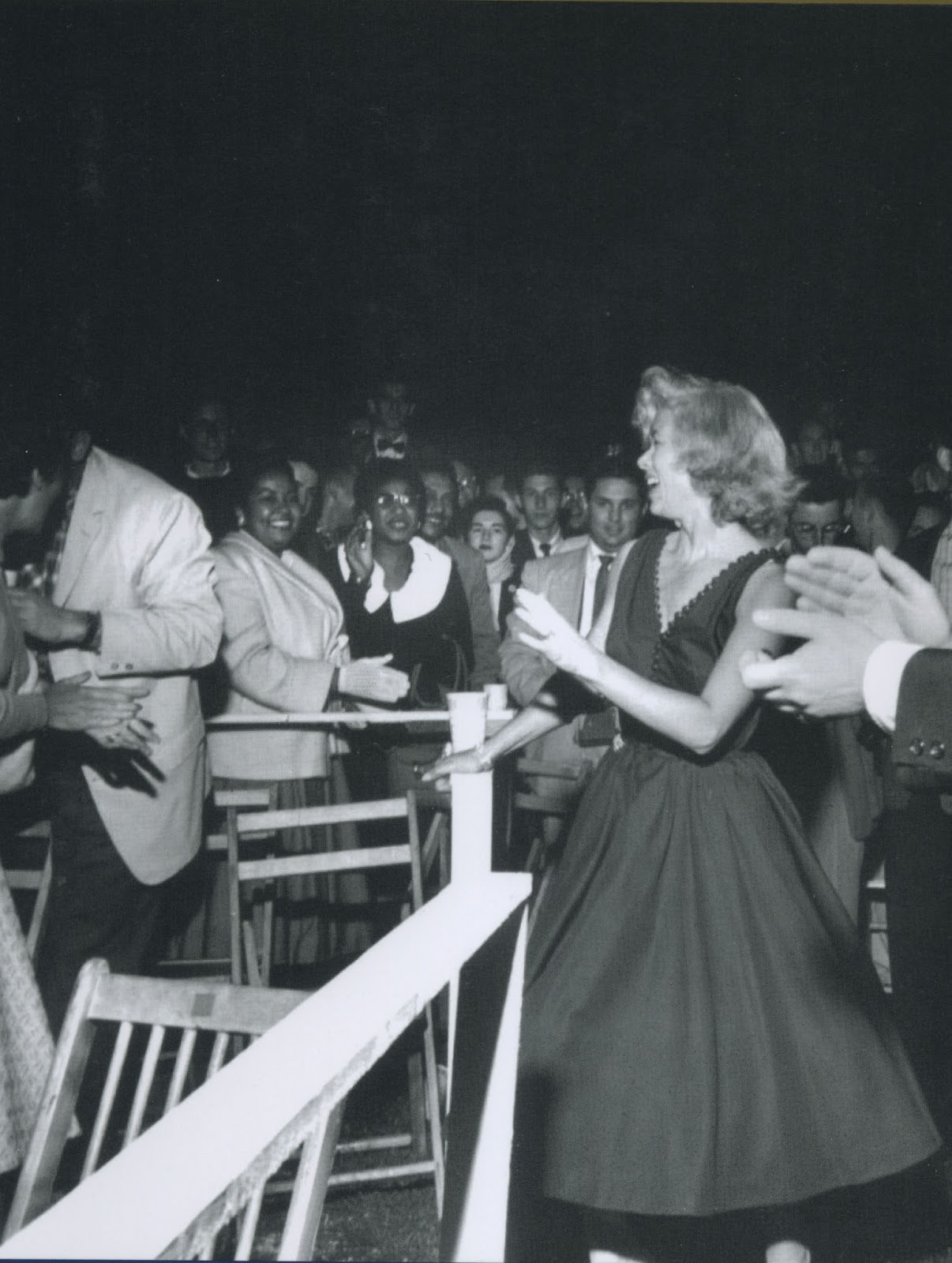
Were I a writer, the story of Elaine Anderson – the girl who launched seven thousand cheers at Newport, 1956 – is certainly a story to which I would turn my hand.

Famously, Elaine Anderson danced through the twenty-seven choruses of Paul Gonsalves’s extemporized tenor solo during the interval between Diminuendo and Crescendo in Blue.

You can imagine the trajectory of the plot: the bored housewife, simmering gently behind the stucco façade of her des res in Rhode Island; the stifling small-mindedness and triviality of the upper set; cabined, cribbed and confined now, a mother of two, the woman still in the first flush of youth who once entertained a career on the stage. For one night only, her lithesome and incendiary Terpsichore caught in the explosions of countless cameras, she wakes the next morning to find her picture across all the newspapers and, eventually on the back cover of the album that signaled Duke Ellington’s renaissance. The mutterings of her discontented husband at her antics, the fame of which spreads far and wide; the slow disintegration of her marriage; the flight to Europe and Paris…

Or maybe not.

And yet. That moment, that minute (and each second in it…) has come to stand for something quite significant. Before the swinging sixties (and, after all, the sixties didn’t invent swing anyway), perhaps, here is a moment of self-transcendence, of feminine –rather than feminist – liberation. A stage on the road to Woodstock?

I’ve spent a pleasant half term holiday reading Backstory in Blue by John Fass Morton. It is a fascinating book which holds up the jewel of Ellington’s famous performance at the jazz festival to the light and examines every facet.

It was, allegedly, Basie drummer Jo Jones keeping time with a rolled up newspaper, the insidious beat picked up by bassist Jimmy Woode and drummer Sam Woodyard which telegraphed the excitement upon which Gonsalves strung his barnstorming solo which, in turn, was the twitch upon the thread which made Miss Anderson dance.

Thinking about the very next album Ellington waxed as art of his new contract with Columbia, I found myself ahead of Mr Morton, for the events highlighted at Newport make a sudden sort of sense of A Drum is a Woman. Morton draws particular attention to the composition Congo Square – but, of course, the whole album is a paean to a woman as the seductive beat of the music. And just look at the ‘cheesecake’ cover. One might think the art department would have looked elsewhere to represent the beat of African music but, then, blondes, as we all know, have more funds… I wonder is the cover a nod to Miss Anderson?

The only quibble I would have with Mr Morton is in his assertion that in her short dance career, Elaine Anderson appeared in Frank Sinatra’s first starring movie Step Lively. Now, whilst the Internet is hardly a fount of information beyond reproach, a little surfing and I found that credit going to the Elaine Anderson who became, later, Mrs John Steineck (another Ellington coincidence with his Suite Thursday tribute to the writer). Confusion is, perhaps, maintained since Elaine Anderson Steinbeck died in 2003, just two years before Elaine Anderson nee Zeitz. I wonder, can clarification on this point be forthcoming?

Elaine’s story, that of Paul Gonsalves and Ellington’s career immediately prior to Newport; developments in popular music at the time and the festival scene are told in fascinating detail in John Fass Morton’s book which is available here.

Maybe it is stories which will draw the uninitiated into the music. 

Friday, 17 February 2012

His Maestro's Voice


A fascinating archive of contemporary reviews of Ellington records from the magazine Gramophone (‘The world’s authority on classical music since 1923’) can be accessed here.

Monday, 2 January 2012

All the fun...

Here are what the poet called 'Kodak-distant' memories - some home cine footage uploaded recently to Youtube. The film was taken at the New York State Exposition, Empire Court, Syracuse, 1963 between 28 August and 2 September, a week long engagement for Duke Ellington and his Orchestra who feature in the early shots...