Great news! New season for The Royal Birmingham Conservatoire's Ellington Orchestra directed by Jeremy Price begins Monday, 29th October with a performance of Black, Brown and Beige.
Anahid Ajemian, Duke Ellington, and Dimitri Mitropoulos in a promotional photograph for the Music For Moderns series, spring 1957.
Music For Moderns at Town Hall, 1957by Matthew Snyder, Archivist, Special Collections, New York Public Library for the Performing Arts, Dorothy and Lewis B. Cullman CenterAugust 19, 2016
During the 1950s, the producer George Avakian, director of both the Popular Album and International Departments of Columbia Records, was recording and releasing vast amounts of music from numerous and varied artists, including Louis Armstrong, Duke Ellington, Miles Davis, Mahalia Jackson, Dave Brubeck, Lotte Lenya, Erroll Garner, Tony Bennett, Benny Goodman, Buck Clayton, Edith Piaf, and Johnny Mathis. A few years earlier, he had also produced recordings by the composers John Cage and Alan Hovhaness.
Simultaneously, his wife, violinist Anahid Ajemian, was busy as a soloist and in a duo with her sister, pianist Maro Ajemian, performing and promoting new music from the likes of Cage, Hovhaness, Lou Harrison, Wallingford Reigger, and Henry Cowell, among others. Ajemian and Avakian began to notice their musical worlds overlapping more and more as jazz musicians became interested in composition, and performers began to become adept in both jazz and classical music. They also sensed audiences could be open to this cross-fertilization.
In 1957, at the suggestion of the publicist Alix Williamson, the couple co-produced a highly, perhaps even radically innovative four-concert series at Town Hall. Titled Music For Moderns, it brought together their friends and colleagues in jazz, classical, and gospel music. In an interview with Voice of America DJ Willis Conover, Avakian stated that the series was "designed to expand the listening pleasures of audiences who may not realize that both certain kinds of jazz and certain kinds of classical music can be presented on the same programs without any incongruity or loss of unified idea behind the programs."
The series brochure stated:
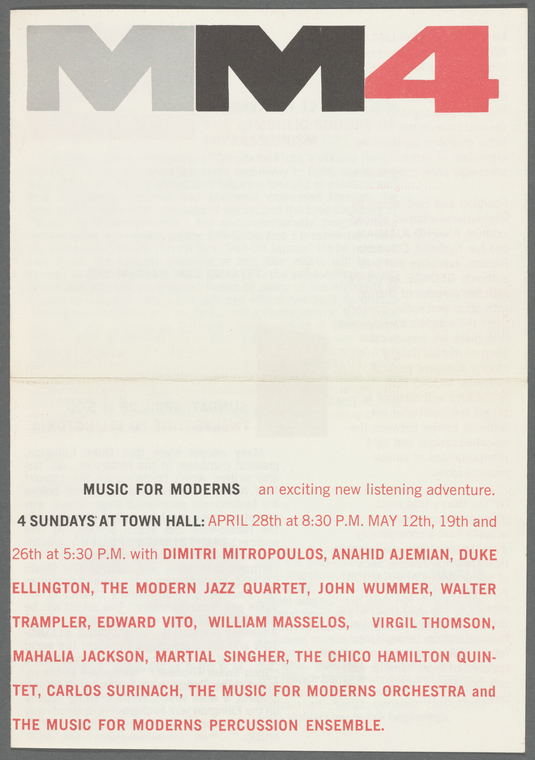
On the theory that most intelligent music-lovers actually have a considerably wider range of musical interest than they may realize, each of the programs in the MUSIC FOR MODERNS series will explore similar and contrasting uses of the same basic materials, thus extending, through logical relationships, the musical horizons of those familiar with only one aspect of the program content.
The brochure for the series.
The opening night (April 28th) was titled “From Twelve Tone To Ellingtonia.” In the first half, Anahid Ajemian performed Kurt Weill’s Concerto for Violin and Wind Orchestra, Op. 12, with Dimitri Mitropoulos conducting. Though premiered in 1925, the piece was lost for some years before Lotte Lenya, Weill’s widow, re-discovered the score among his papers. Ajemian gave the piece its American premier and recorded It in 1955 for MGM, with Izler Solomon conducting.
The second half featured the Duke Ellington Orchestra in the world premiere of Ellington and Billy Strayhorn’s Such Sweet Thunder, a suite based on characters of William Shakespeare which had been commissioned by the Stratford Shakespeare Festival in Ontario, Canada. It is recognized today as one of the best of Ellington and Strayhorn’s extended works. The suite was later recorded for Columbia (produced by Irving Townsend), but this premiere performance, along with the Weill/ Ajemian/Mitropolous performance, was recorded, and the tapes are now held by the Rodgers and Hammerstein Archives of Recorded Sound in the George Avakian and Anahid Ajemian recorded sound collection.
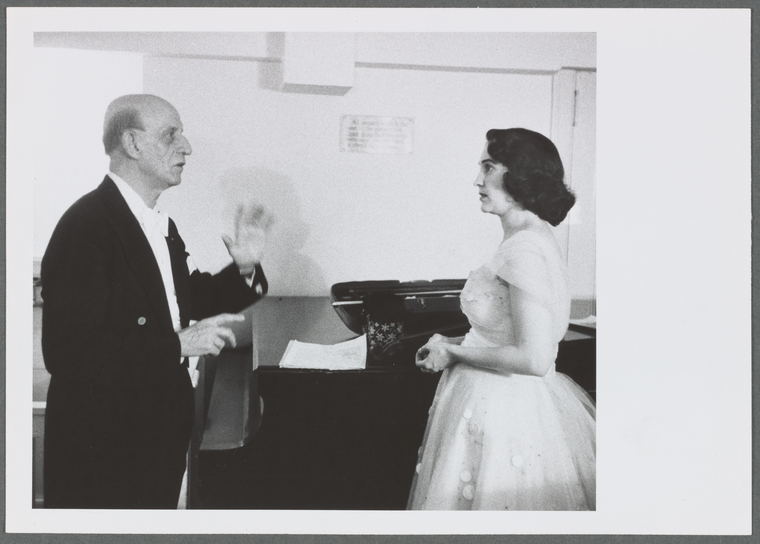
Dimitri Mitropoulos with Anahid Ajemian backstage at Town Hall, April 28th, 1957.
The second night of the series, on May 12th, was titled “The Symbolic Sounds of Impressionism.” It featured the Modern Jazz Quartet performing John Lewis’s music for the French film Sait-on Jamis (No Sun In Venice); Claude Debussy’s Trio Sonata for Viola, Flute, and Harp performed by Walter Trampler, John Wummer, and Edward Vito; and Erik Satie’s Sports et Divertissements, performed by pianist William Masselos.
The latter was a multi-media event: Because the piece was written to accompany a set of 20 watercolor drawings by Charles Martin in 1913, Martin’s drawings were reproduced and projected at Town Hall, and the composer and writer Virgil Thomson recited his translation of Satie's preface and commentary on each of the 20 movements. Avakian referred to it as "the complete experience on three levels."
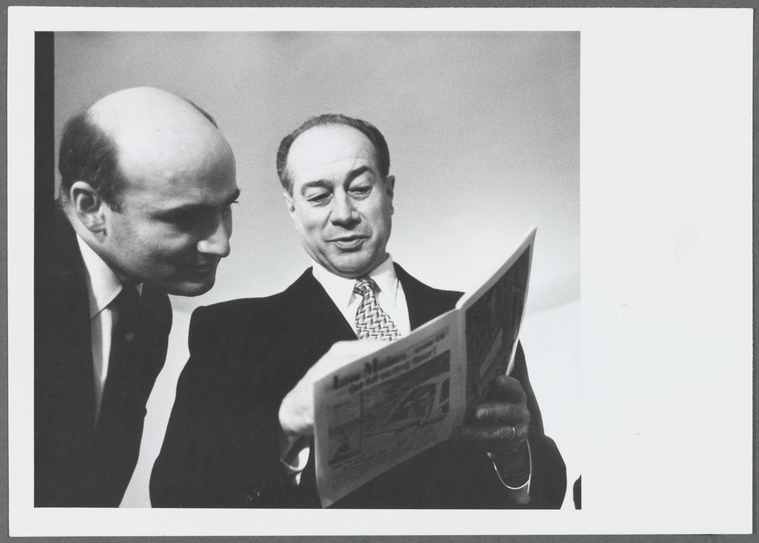
George Avakian with Martial Singher.
The third concert, on May 19th, was titled "Variations on the Folk Theme." Mahalia Jackson sang Gospel songs and spirituals in the first half, followed by Martial Singher, French baritone of Metropolitan Opera, singing European songs with folk origins.
The finale of the series on May 26th was called “New Dimensions.” The first half showcased the Chico Hamilton Quintet (Paul Horn, reeds, Fred Katz, cello, John Pisano, guitar, Carson Smith, bass, and Hamilton, drums) performing a set of world premieres written for this program, one of which, Concerto Petite, by Fred Katz, featured Anahid Ajemian guesting with the group. Hamilton’s set was recorded by Pacific Jazz, but not released in full until Mosaic Records' 1997 issueThe Complete Pacific Jazz Recordings of the Chico Hamilton Quintet.
In the second half, the composer Carlos Surinach conducted a group of three pieces for percussion orchestra: Carlos Chavez’s Toccata for Percussion, Alan Hovhaness’s October Mountain (a world premiere); and Surinach’s own Ritmo Jondo. (The Avakian/Ajemian collection holds a recording of this portion of the concert.)
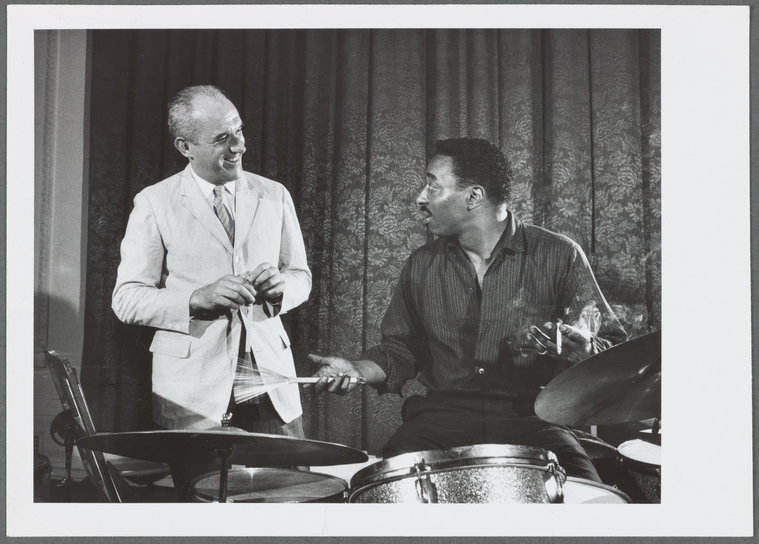
Carlos Surinach with Chico Hamilton in rehearsal.
Music For Moderns received good audience feedback and reviews, although Ajemian and Avakian lost money on the venture. Nevertheless, they made history: it was one of the first times that such an extensive and adventurous blending of musical worlds was presented in the United States, or possibly anywhere, and not just for one night, but for four. These programs still look ground-breaking in 2016; they demonstrate a trust in the audiences, and an assumption that they could digest and find value in music they did not know, an astonishing concept for many in 1957, and one still worth considering.
George Avakian, Duke Ellington, unidentified, Lotte Lenya, and Anahid Ajemian at Town Hall after the opening concert of Music For Moderns, April 28th, 1957.
When I began this blog ten years ago - or it will have been on the 18 October this year, I found the perfect photograph for the title header - a distant church tower in the background contributing to the provincial town or 'ville' of the title. Here is the full photograph:
The story behind the photograph was told in the special edition of Ellington Society UK's journal Blue Light which was also the conference programme. I've reproduced the article below. In researching the photograph for another article for the journal, I discovered two other photographs and to my delight some colour film of the occasion. The 'screen shot' at the top of this post is taken from this newsreel footage which may be found at theBay Area Television Archive here. The other photographs I have managed to source, I have included at the foot of the article here. This is a very long shot, but if you are reading this and were one of the students (or staff!) who were present on the occasion of Ellington's visit, please get in touch!
Here is the article, told here in his own words by the late Dr. Herb Wong, life-long jazz and Ellington aficionado and Principal of Washington Elementary School. The essay is drawn from interviews conducted in 1998 by Caroline Crawford, University of California, Berkeley, California who graciously gave permission to quote from their conversations. You can read - and download the PDG of the full interview with Dr Wonghere.
Jazz Goes To Collage
In the late 1960s, while working on developing a curriculum for the Berkeley School District’s primary classes, I happened to play an Ellington tune to a group of elementary school kids, asking them to write down and draw their thoughts as they listened to the music. When I read their reactions, my reaction was to read their writings to Duke. The next time he called (Duke called frequently, often at 3:00 or 4:00 in the morning, while he was up all night composing) I was ready, with my students’ essays by the bed.
I read a couple of the letters to him: “When I hear Duke’s music I have this deep down, brown feeling in my tummy,” said one of the kids; “When I hear Duke’s music, it’s like giant valentines floating up in the sky,” said another.
Duke listened for a moment and then said, “Who are these people? Who are these authors, these poets?”
“Oh,” I said, “Probably about the same age as when you started.” He said, “Then how old was I?” That's the way he said it; he's so delightful. He said, “How old was I?” I said, “Oh, probably five or six.”
I said, “Okay, now listen to my challenge. I've gone over as much of your music as possible. I can't identify all of them, but I kind of connected to the inspirational sources and what imagery you might have had that prompted you to think about a tune or
a title or something. Correct me if I'm wrong. Of all the different areas in the world that you have drawn from as inspirational sources, I don't think you have included young children. Now, tell me right away if I'm goofing.”
There was silence on the other end. And I'll never forget this. It was a longer silence than I thought I would ever hear from him, and then he said, “Oh my god. I think you have found a hole in my thing, and I would appreciate it, Herb, if you would help me to fill that hole up as soon as possible. Will you do that?”
I said, “Look, while you're in Las Vegas, you're not that far away from Berkeley. Do you think that you might come to school and perhaps do a concert, say, in your last week?”
So he said, “Well, that's an interesting idea. Okay. Let's think about that.”
I brought Duke over there to the rehearsal at Berkeley High.
By the time I brought him to the school and we got out of my car—in fact, as we approached—I couldn't believe it—the place was jammed with thousands of people, absolutely packed. I thought, “Wow! What the hell is this?” We got out of the car, and there were channels 4, 5, 7, whatever—9—I don't know. They were all there, taping what was going on. Duke was dressed very informally, because his formal stuff was not with him... because that was being brought by the band bus later with the guys.
Well, we took three steps up to the yard, and we walked in. It was a sunny day, and there were all these cameras and all these signs and posters and stuff from other schools. A lot of kids from other schools came with their principals, who knew I was doing this and didn't just stay in their habitat— they brought children.
Now, this next incident is priceless. A little black girl, five years old came up to Duke and yanked on his jacket that was over his left arm. She looked up at him and said, “Mr. Ellington, I know you're very old, but your music sounds so young.”
Yesterday was guitarist Kenny Burrell's 87th birthday.
Kenny Burrell is a great admirer of Duke Ellington's work and indeed ran a course -Ellingtonia - in teaching his music at UCLA. A former student, Steve Bowie, incidentally, hosts a superb podcast Ellington Reflections.
In celebration of Mr Burrell's birthday, I have been listening to the second volume of his Ellington is Forever albums which has the added attraction of Ellington trombonist Quentin Jackson, who is also featured on a couple of vocals!
Here is a quotation about Ellington's Great Paris Concert album. This was posted to the Duke Ellington Societygroup onFacebook by the group's organiser Jean-Marie Juif (the Society is recommended!)
The comments show one great musician's appreciation of the work of another.
KENNY BURRELL speaks about Duke's Great Paris Concert album (Atlantic Records) at the University of California, Los Angeles, May 7, 2013:
"The record the maestro recorded in Paris in 1963; there are many great things on this recording.
It starts off with Rockin' in Rhythm which we all know has gotten it's own wings after Ellington.Written in 1929 - hello! - Zawinul and those guys were do it later.
Star Crossed Lovers from the Suite,the Theme from the Asphalt Jungle movie,couple of pieces featuring Cootie Williams, Concerto for Cootie, Tutti For Cootie and The Suite Thursday another suite by Ellington and Strayhorn.
One that I particularly like - well I have to say it's one of favourite pieces in all of Ellingtonia - and all music is Tone Parallel To Harlem known as Harlem Suite.
This was commissioned in 1950 by Arturo Toscanini of The NBC Symphony Orchestra of New York.
Ellington at that point was pretty popular and also gaining recognition as a serious composer so that's why he got the commission - at the time he was fifty one.
That piece has been recorded in many formats including symphony orchestras both here and in Europe and on various occasions by Ellington himself with his band - this happens to be one of my favourite versions of it.
First of all I love the composition, I think it's one of the most outstanding musical compositions ever written, certainly (ever written) by Ellington.
It's a through composed piece of material - and it is jazz, not a lot of improvisation in this piece because it's through composed.
But the main thing about this - it is a great extended composition of jazz music - that only Ellington could do.
I would encourage anyone to listen this, it happens to be my favourite version of it - and this a live performance in Paris in 1963.
One of the things you should listen to this piece of music is the huge variety of time changes - the huge variety of harmonic changes - the huge variety of tonal colour - of shifting around.
It's amazing how he could get such variety with fifteen musicians - it's unbelievable, but he managed to do that and that's why he's considered many the greatest - not only the greatest jazz composer of the twentieth century but the greatest composer of the twentieth century and this is coming from some serious classical musicians who feel that way - let alone jazz musicians who feel that way.
The classical people are starting to say this is some new - material done in a highly sophisticated way that has never been done before - so that's why I wanted to talk about this record!
It's like all great art - the more you listen, the more you look - the more you hear, the more you see - I never tire of hearing this.
Listen closely and something else reveals itself."
Uploaded to Youtube on 21 July, 2018, a KNXT tribute to Duke Ellington. The poster writes:
"KNXT-2 May 24, 1974 CBS Movie Opening & Tribute to Duke Ellington all tapes are cleaned and baked before transfer. please keep in mind the quality Matters on condition of machines and how they were recorded plus tape stock Used. Also Many of These Recordings were Recorded Off Rabbit Ear Antenna, s Not Cable Tv Yet"
From a recent sale on eBay, photographs of ticket stubs for a performance by Duke Ellington at the Memorial Auditorium,College Green, University of Ohio on 31 January 1974.
And here is some further information from The College Yearbook, 1974...(though, sadly, Ellington did not reach the age of 78...)
Happy times with Royal Birmingham Conservatoire's Ellington Orchestra and head of Jazz, Jeremy Price at the conclusion of the 25th International Duke Ellington Study Group Conference, 27th May, 2018
It is over a month now since the 25th International Duke Ellington Study Group Conference took pace at the Royal Birmingham Conservatoire, Birmingham City University.
The exam season and various other matters have prevented me from writing about the event until now.
The conference itself, the keynote speeches, the papers presented, the live music, facilities, accommodation and food were all superb. In terms of the research, study and performance of Ellington's work within the UK, the conference is likely to have far reaching consequences and hugely exciting projects are in development.
For now, I would like to say thank you to the key note speakers, the presenters who came from the world over to address the conference, the delegates who supported the event and the members of the Duke Ellington Society of Sweden and Duke Ellington Society UK in particular. Most of all, I would like to thank Dr Nicolas Pillai of Birmingham School of Media, Birmingham City University who worked tirelessly to organise the conference and Jeremy Price, Head of Jazz, Royal Birmingham Conservatoire.
I cannot in fact, say thank you enough for the hard work, generosity and kindness shown by staff and students involved in organising and staging the conference.
Nic and Jeremy could not have been more accommodating and supportive of the idea of hosting a conference at the Conservatoire. Their dedication, enthusiasm and professionalism were striking. The organisation of the conference on a practical level was also exceptional and Laura Carney from the Events Office was unstinting in the help, support and advice she offered.
The students of the Conservatoire’s Ellington Orchestra rose to the occasion magnificently, giving of their time generously in staging four concerts, including a farewell set on Sunday morning. They are fine young musicians led by staff who nurture and encourage them to uncompromisingly high standards. The musicians are excellent ambassadors for Ellington’s music and, of course, for the Conservatoire itself.