Sunday, 29 April 2012

Monday, 16 April 2012
Cloud Nine

It is remiss of me not to record here the passing of Kay Davis, coloratura, on 27 January, 2012 at the age of 91.
I was reminded of her transcendent vocal work when I happened upon a rare film of her singing one of her most famous pieces, On A Turquoise Cloud. The performance comes from a Universal short, Symphony in Swing (1949). The brief passage is embedded in Leonard Feather’s The Duke Ellington Story which I happened upon in one of my frequent blue rambles through the net.
Subsequently I found a little more of the film which is posted here also in tribute to a remarkable lady.
Thank you for Kay Davis.
Sunday, 15 April 2012
Peerless

Admirers of Duke Ellington’s music are blessed with the quality of the scrutiny scholars continue to bring to bear on his work.
Their studies offer fresh perspectives, provide opportunities for us to revisit pieces which sometimes fall into unjustified neglect, help us to understand a little more and appreciate a little better his achievements.
It has been a particular pleasure recently for me to play Ellington and Strayhorn’s Peer Gynt Suite and to spend time absorbing a new study on this masterwork.
Duke Ellington, Billy Strayhorn and the Adventures of Peer Gynt in America is a study which has been written by Anna Harwell Celenza, Thomas E. Caestecker Professor of Music at Georgetown University.
When it was first issued, Ellington and Strayhorn’s arrangement of Grieg’s music for Ibsen’s play was banned from broadcast in the composer’s native Norway. Ellington remained circumspect about this slight to the end of his life. The suite received largely indifferent notices elsewhere and whilst his version of the Nutcracker has become something of a Christmas staple and is often performed in the repertoire of many outfits, Peer Gynt was never performed live by the Ellington band nor – so far as I am aware – by anyone else.
Having read Anna Celenza’s work, I can see now that the reason for this is largely lack of appreciation of Ellington and Strayhorn’s artistic intention and the scope of their achievements. Anna's study more than redresses the balance and is invaluable. I will not repeat the argument of her study here: let the reader discover that for himself in prose more elegant and incisive than I can muster. Suffice it to say, Anna’s work sheds new light on the literary influences of translations of Ibsen’s play, of previous performances, of Strayhorn’s influence and the political context in which the musicians were working. Music samples and a fascinating account of the recording sessions are also available. The study can be downloaded for free and comprises part of the Summer 2011 edition of the on-line journal Music and Politics, Volume V Number 2 of which can be found here.
Monday, 9 April 2012
Scoring a Century

“Fate is being kind to me. Fate doesn’t want me to be too famous too young” Duke Ellington (famously) said on being passed over for the Pulitzer Prize in 1965.
Fate is still playing catch up with the scope of Ellington’s achievements. David Schiff’s new book The Ellington Century offers something of a helping hand along the road to enlightenment, however.
A companion piece in many ways to Harvey G Cohen’s recent study Duke Ellington’s America, like this earlier volume, Schiff sheds new light on the political nature of Ellington’s work – where the musician did not always receive the credit he deserved during his own lifetime.
The Pulitzer board’s slight was one of the ways in which Ellington did not receive the credit he deserved for his music, either. And it is as a study of his music that Schiff’s book is particularly valuable.
Ellington heard in colour. In the earlier chapters of his book, David Schiff argues that the quality of these ‘tone parallels’ Ellington created deserve their place amongst the works of Ravel or Debussy. Schiff is not trying to legitimize Ellington’s efforts in some way by arguing that somehow Ellington’s music can be judged by the standards of Western European culture. That would be a betrayal of Ellington’s complete disdain for critical categorization. Rather, Schiff argues that in terms of craftsmanship, serious intent and artistic value, Ellington’s evanescent, transcendent forms are the equal of European achievements in this sphere. That Ellington’s music was not the product of the hot house or conservatoire, but written, often, in transit while he tried to keep a working dance band on the road; that his music reached out to popular forms, celebrated the ‘gut’ rather than the ‘nut’, makes his achievements all the more remarkable and explains why he is ‘beyond category’.

From John Hammond to James Lincoln Collier, Schiff dismisses the charges of pretension or charlatanism that critics of this stripe have levelled against Ellington. His account of the creation of pieces such as Reminiscing in Tempo and Sugar Hill Penthouse is, above all, very moving. Ellington wrote out of his own life, using the materials – as he said himself once – nearest to hand. The life was the work – and I don’t know any better definition of genius than that.
Finally, Schiff turns his attention to the Sacred Concerts, works that continue to create only indifference in certain critical quarters. Schiff argues that David Danced Before The Lord brings Ellington’s oeuvre full circle. Schiff would extend the number of Sacred pieces to five, including the 1958 recording of Black, Brown and Beige and 1963’s My People and his reading makes clear the extent to which these works were charged politically for the composer: that freedom was both present and becoming.
Sunday, 18 March 2012
Cordon blues

If, as Duke Ellington said, the art is in the cooking, then the new album from Laurent Mignard’s Duke Orchestra is Haute Cuisine.
As the album title implies, Ellington French Touch gathers material which has a Ducal connection to France. It is a rich harvest drawn, principally, from the mellow fruitfulness of Ellington’s late period, post Newport.
The album divides, effectively, into three acts: music composed for the film Paris Blues; music drawn from Midnight in Paris – one of the last albums Ellington completed as part of his Columbia contract and music for the stage play Turcaret. Adding spice to the dish, however, the album also includes Billy Strayhorn’s arrangement of Sacha Distel’s The Good Life (a suitable motif for the world the album conjures), The Goutelas Suite and The Old Circus Train which was created ad hoc during the band’s visit to the Cote d’Azur in 1966.
It is a rare selection. The album Midnight in Paris has never been issued on compact disc in Ellington’s own native country – and disappeared very quickly in its French pressing for Sony in the 1990s. This album is the only way you can hear this music at present – outside of vinyl copies from Internet auction houses. You cannot hear the music from Turcaret anywhere else and Laurent Mignard has reconstructed The Goutleas Suite from scraps at the Smithsonian. One cannot tell where Ellington ends and Mignard begins which is testament enough to the musician’s devotion to –and expertise in – the works of Ellington.
In my opinion, there cannot be any finer labourers in Duke’s vineyard than the members of this Orchestra. The musicianship is superb and the band’s performance, recorded live in Clamart in December last year, has been captured perfectly by Bruno Minisni. Aside from a brief trip to an Irish jazz festival, I don’t think the Orchestra has played live outside of France yet, but I do hope one day to catch a concert. The orchestra is quintessentially Ellington, without being a pale Xerox – as ghost bands are wont to sound – of the original. There are no slavish note-for-note copies of the solos, for example. And indeed with musicians of the taste and imagination of Aurelie Tropez, for example, and Fred Couderec (whose solo on Frontin is particularly transcendent) why would there be? And besides, thanks to Laurent Mignard’s scholarship and dedication, there is much new wine here, anyway. The album comprises an essential addition to any devotee’s collection of Ellington’s music. More details about the album may be downloaded here.
There is a promotional video here.
There is a promotional video here.
Sunday, 19 February 2012
The girl who...
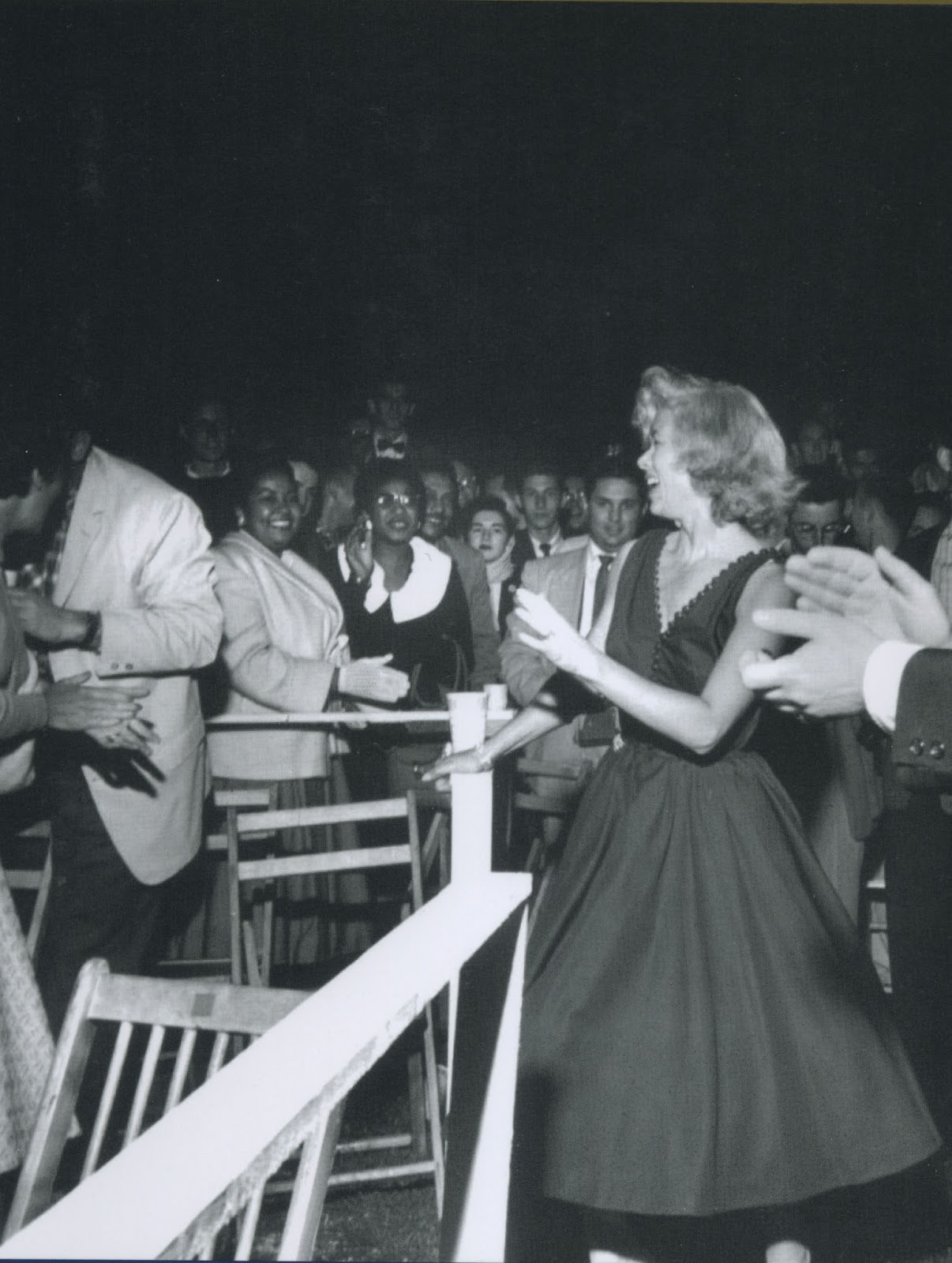
Were I a writer, the story of Elaine Anderson – the girl who launched seven thousand cheers at Newport, 1956 – is certainly a story to which I would turn my hand.
Famously, Elaine Anderson danced through the twenty-seven choruses of Paul Gonsalves’s extemporized tenor solo during the interval between Diminuendo and Crescendo in Blue.
You can imagine the trajectory of the plot: the bored housewife, simmering gently behind the stucco façade of her des res in Rhode Island; the stifling small-mindedness and triviality of the upper set; cabined, cribbed and confined now, a mother of two, the woman still in the first flush of youth who once entertained a career on the stage. For one night only, her lithesome and incendiary Terpsichore caught in the explosions of countless cameras, she wakes the next morning to find her picture across all the newspapers and, eventually on the back cover of the album that signaled Duke Ellington’s renaissance. The mutterings of her discontented husband at her antics, the fame of which spreads far and wide; the slow disintegration of her marriage; the flight to Europe and Paris…
Or maybe not.
And yet. That moment, that minute (and each second in it…) has come to stand for something quite significant. Before the swinging sixties (and, after all, the sixties didn’t invent swing anyway), perhaps, here is a moment of self-transcendence, of feminine –rather than feminist – liberation. A stage on the road to Woodstock?
I’ve spent a pleasant half term holiday reading Backstory in Blue by John Fass Morton. It is a fascinating book which holds up the jewel of Ellington’s famous performance at the jazz festival to the light and examines every facet.
It was, allegedly, Basie drummer Jo Jones keeping time with a rolled up newspaper, the insidious beat picked up by bassist Jimmy Woode and drummer Sam Woodyard which telegraphed the excitement upon which Gonsalves strung his barnstorming solo which, in turn, was the twitch upon the thread which made Miss Anderson dance.

The only quibble I would have with Mr Morton is in his assertion that in her short dance career, Elaine Anderson appeared in Frank Sinatra’s first starring movie Step Lively. Now, whilst the Internet is hardly a fount of information beyond reproach, a little surfing and I found that credit going to the Elaine Anderson who became, later, Mrs John Steineck (another Ellington coincidence with his Suite Thursday tribute to the writer). Confusion is, perhaps, maintained since Elaine Anderson Steinbeck died in 2003, just two years before Elaine Anderson nee Zeitz. I wonder, can clarification on this point be forthcoming?
Elaine’s story, that of Paul Gonsalves and Ellington’s career immediately prior to Newport; developments in popular music at the time and the festival scene are told in fascinating detail in John Fass Morton’s book which is available here.
Maybe it is stories which will draw the uninitiated into the music.
Friday, 17 February 2012
His Maestro's Voice

A fascinating archive of contemporary reviews of Ellington records from the magazine Gramophone (‘The world’s authority on classical music since 1923’) can be accessed here.
Subscribe to:
Posts (Atom)