Saturday, 15 July 2023

Discography: Ellington In Order Volume 1 (1927-28)


Duke Ellington In Order Volume1 (1927-28)

Evelyn Preer
New York City, NY     

10 January 1927

Victor recording session

Bubber Miley(t); n/k(cl,ts); Edgar Sampson(as,vn); Otto Hardwick(as); Duke Ellington(p); Sonny Greer(d); EPr(v)

If You Can't Hold The Man You Love- vEPr         


Duke Ellington and his Washingtonians

New York City, NY     

22 March 1927

Columbia recording session

Bubber Miley, Louis Metcalf(t); Joe Nanton(tb); n/k(cl,as); Edgar Sampson(as); Otto Hardwick(cl,ss,as,bar,bsax); Duke Ellington(p); Fred Guy(bj); Mack Shaw(bb); Sonny Greer(d)

East St. Louis Toodle-O        

Hop Head                   

Down In Our Alley Blues     


Duke Ellington and his Orchestra           

New York City, NY  

6 October 1927

Victor recording session

Bubber Miley, Louis Metcalf(t); Joe Nanton(tb); n/k(cl,as); Edgar Sampson(as); Otto Hardwick(cl,ss,as,bar,bsax); Duke Ellington(p); Fred Guy(bj); Mack Shaw(bb); Sonny Greer(d)

Washington Wobble  (Take 1)

Washington Wobble  (Take 2)


Duke Ellington and his Orchestra           

Camden, NJ    

26 October 1927

Victor recording session

Bubber Miley, Louis Metcalf(t); Joe Nanton(tb); n/k(cl,as); Edgar Sampson(as); Otto Hardwick(cl,ss,as,bar,bsax); Duke Ellington(p); Fred Guy(bj); Mack Shaw(bb); Sonny Greer(d) Adelaide Hall(v)

Black And Tan Fantasy  

Washington Wobble (Take 5)

Creole Love Callv AHa        

The Blues I Love To Singv AHa      

The Blues I Love To Singv AHa      


Duke Ellington and his Orchestra           

New York City, NY 

3 November 1927

Okeh recording session

Jabbo Smith, Louis Metcalf(t); Joe Nanton(tb); Rudy Jackson(cl,ts); Otto Hardwick(cl,ss,as,bar,bsax); Harry Carney(cl,as); Duke Ellington(p); Fred Guy(bj); Wellman Braud(sb); Sonny Greer(d); Adelaide Hall(v)

What Can A Poor Fellow Do?          

Black And Tan Fantasy       

Chicago Stomp Down- vAHa          


Duke Ellington and his Orchestra

New York City, NY     

19 December 1927

Victor recording session

Bubber Miley, Louis Metcalf(t); Joe Nanton(tb); Rudy Jackson(cl,as); Otto Hardwick(cl,ss,as,bar,bsax); Harry Carney(cl,ss,as,bar); Duke Ellington(p); Fred Guy(bj); Wellman Braud(sb); Sonny Greer(d)

Harlem River Quiver           

Harlem River Quiver           

Harlem River Quiver           

East St. Louis Toodle-O        

Blue Bubbles            

Blue Bubbles            


The Washingtonians          

New York City, NY     

9 January 1928

Columbia recording session

Bubber Miley, Louis Metcalf(t); Joe Nanton(tb); Rudy Jackson(cl,as);Barney Bigard(cl,ts); Otto Hardwick(cl,ss,as,bar,bsax); Harry Carney(cl,ss,as,bar); Duke Ellington(p); Fred Guy(bj); Wellman Braud(sb); Sonny Greer(d)

Sweet Mama,Papa's Getting Mad

Stack O'Lee Blues     

Bugle Call Rag


Duke Ellington and his Orchestra   

New York City, NY     

19 January 1928

Okeh recording session

Bubber Miley, Louis Metcalf(t); Joe Nanton(tb); Barney Bigard(cl,ts); Otto Hardwick(cl,ss,as,bar,bsax); Harry Carney(cl,ss,as,bar); Duke Ellington(p); Fred Guy(bj); Wellman Braud(sb); Sonny Greer(d)

Take It Easy  

Jubilee Stomp           

East St. Louis Toodle-O (Harlem Twist)   


Duke Ellington and his Cotton Club Orchestra

New York City, NY 

26 March 1928

Victor recording session

Arthur Whetsel, Bubber Miley, Louis Metcalf(t); Joe Nanton(tb); Barney Bigard(cl,ts); Otto Hardwick(cl,ss,as,bar,bsax); Harry Carney(cl,ss,as,bar); Duke Ellington(p); Fred Guy(bj); Wellman Braud(sb); Sonny Greer(d)

Black Beauty            

Jubilee Stomp           

Got Everything But You       


Duke Ellington and his Orchestra

New York City, NY     

10 July 1928

Okeh recording session

Arthur Whetsel, Bubber Miley(t); Joe Nanton(tb); Barney Bigard(cl,ts); Johnny Hodges(cl,ss,as); Harry Carney(cl,ss,,as,bar); Duke Ellington(p); Fred Guy(bj); Wellman Braud(sb); Sonny Greer(d); Irving Mills(v)

Diga Diga Doov IM

Doin' The New Low Down


Duke Ellington         

New York City, NY     

1 October 1928

Okeh recording session

Duke Ellington (p)

Black Beauty            

Swampy River          


Duke Ellington and his Orchestra           

Same session

Arthur Whetsel, Bubber Miley(t); Joe Nanton(tb); Barney Bigard(cl,ts); Johnny Hodges(cl,ss,as); Harry Carney(cl,as,bar); Duke Ellington(p); Lonnie Johnson(g); Fred Guy(bj); Wellman Braud(sb); Sonny Greer(d); Baby Cox(v)

The Moochev v BCx    

Move Over     

Hot And Bothered     

Note: Move Overwas released as Lonnie Johnson’s Harlem Footwarmers


Duke Ellington and his Cotton Club Orchestra 

New York City, NY     

30 October 1928

Arthur Whetsel, Freddie Jenkins(t); Joe Nanton(tb); Barney Bigard(cl,ts); Johnny Hodges(cl,ss,as); Harry Carney(cl,as,bar); Duke Ellington(p); Fred Guy(bj); Wellman Braud(sb); Sonny Greer(d)

The Mooche   


OZZIE WARE with ‘HOT FIVE’      

New York City, NY     

Same session

Victor recording session

Freddie Jenkins(t); Barney Bigard(cl); Duke Ellington(p); Wellman Braud(bb); Sonny Greer(d); Ozzie Ware(v)

Santa Claus, Bring My Man Back To Mev OW   

I Done Caught You Bluesv OW      


Duke Ellington and his Cotton Club Orchestra 

Same session

Arthur Whetsel, Freddie Jenkins(t); Joe Nanton(tb); Barney Bigard(cl,ts); Johnny Hodges(cl,ss,as); Harry Carney(cl,as,bar); Duke Ellington(p); Fred Guy(bj); Wellman Braud(sb); Sonny Greer(d); Irving Mills, Baby Cox,Ozzie Ware(v)

I Can't Give You Anything But Love– v IM,BC (Take 1)     

No Papa No   

No Papa No vOW


Duke Ellington and his Cotton Club Orchestra      

New York City, NY     

10 November 1928

Victor recording session

Arthur Whetsel, Freddie Jenkins(t); Joe Nanton(tb); Barney Bigard(cl,ts); Johnny Hodges(cl,ss,as); Harry Carney(cl,as,bar); Duke Ellington(p); Fred Guy(bj); Wellman Braud(sb); Sonny Greer(d); Irving Mills, Baby Cox(v)

I Can't Give You Anything But Love- vIM, BC (Take 4)


Monday, 3 July 2023

Ellington In Order: Update 3


Some aficionados of Duke Ellington's music have pointed to omissions from the first volume of Ellington In Order

As series producer Charles L. Granata explains, however, they may be "...under the impression that because those labels were at one time owned by ARC that Sony Music still has the rights to them. That is incorrect; those labels were sold to EMI way back in the late 1930s, when CBS formed their radio business and bought the old ARC and revived the Columbia name in the United States. 

There are definitely some perplexities when it comes to all of this label ownership business, so I understand the confusion! For example, in France, EMI distributed some recordings under the 'Columbia' and 'CBS' banners.Therefore, they issued the Complete Duke Ellington  series on LP under the CBS label. Many of the tracks are Columbia-owned masters. However, because EMI also owned the rights to the Pathé and associated label recordings, they were able to 'co-mingle' the sides that EMI had the French rights to with the Columbia-owned sides that they had licensing for in France."

We must look elsewhere, therefore, to other sources for these Cameo and Pathé sides. Duke Ellington In Order remains, however, the most ambitious and comprehensive issue/re-issue programme of the works of Duke and the programme rolls on. Details of Volumes 2 and 3 in the series will be available soon. In the meantime, Ellington Live is building a discography of the series, volume by volume, which may be found here.


Saturday, 1 July 2023

Valediction 2 by Ethan Iverson

 On the eve of the première performance of his new Ellington suite, Valedicition, Ethan Iverson published the following post on Substack...

TT 278: "In A Mellotone" and "Come Sunday"

More on the Ellingtonian theme 

ETHAN IVERSON

Tomorrow and Saturday, during Ellington: From Stride to Strings at the Grange Festival, I am accompanying Dominck Farinacci in “In a Mellotone” and Anush Hovhannisyan in “Come Sunday.”


1940! The first recording of “In a Mellotone” is a classic, pure joy and genius packed into three minutes from the famous Blanton-Webster band. 

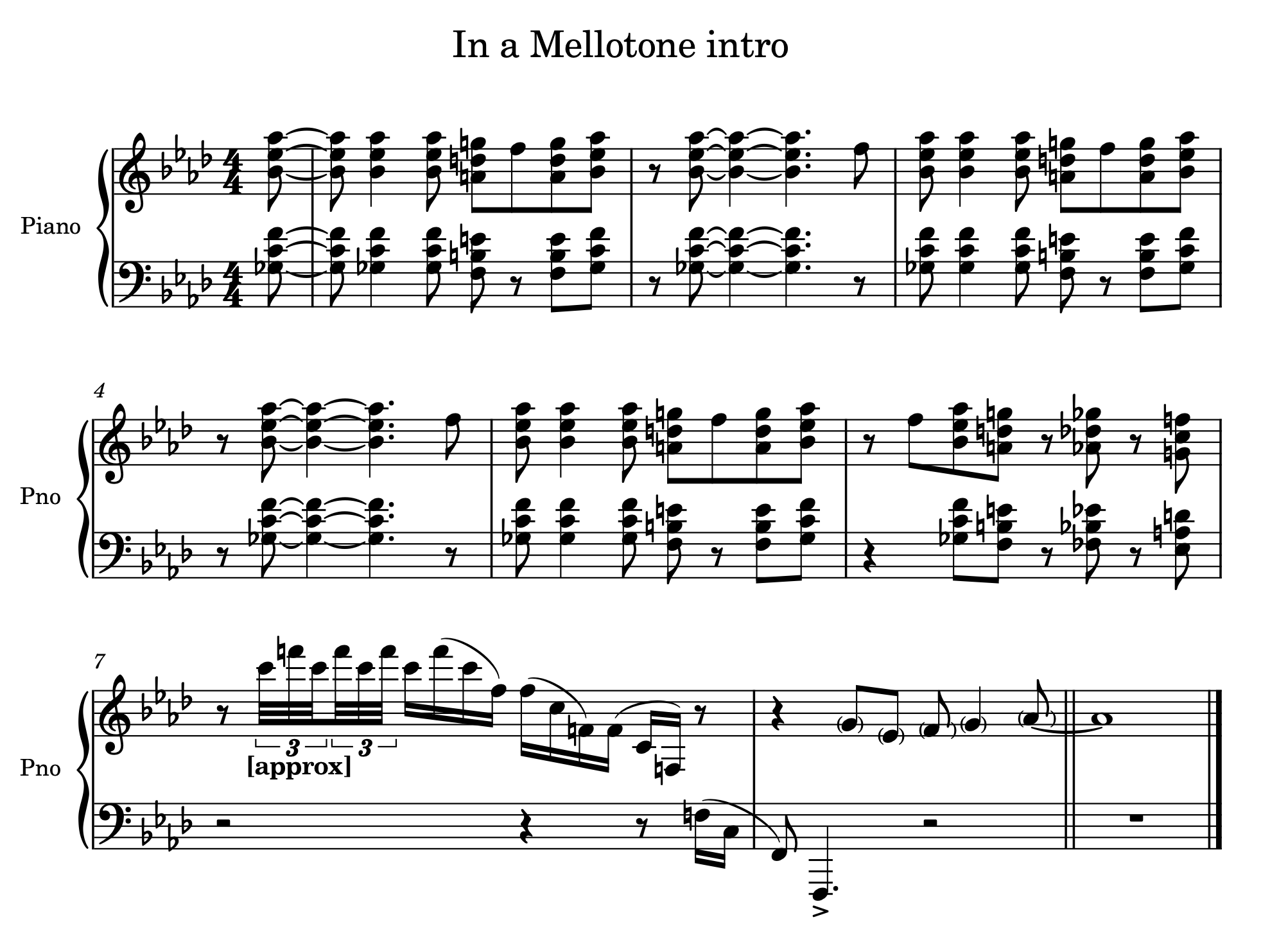
The piano intro seems notably important. I doubt Duke Ellington was exactly the first to utilize these stacks of fourth chords on parallel dominants, but this was surely one of the earliest occasions when they are used for this kind of percussive effect on record. 

Literally everyone has played these voicings since, including Red Garland, Wynton Kelly, Cedar Walton, McCoy Tyner, and Herbie Hancock. 

The piano intro to “In Mellotone” is almost as much part of the tune as the piano intro to “Take the A Train,” but I’ve never heard anyone emulate Jimmie Blanton’s interesting counterpoint underneath.

Cootie Williams and Johnny Hodges take great solos, but it is also noticeable how these cats haven’t heard bebop yet, for Hodges’s many double-time passages sound more like a European technical etude than Charlie Parker. (Later, a Ducal horn soloist like Paul Gonsalves would use bop phrasing in double-time passages.)

There’s also quite a lot of written double-time for the saxes. Indeed, from a purely technical perspective, “In a Mellotone” must be one of the hottest big band charts of the era. 


”Come Sunday” was premiered as part of Black, Brown and Beige. The famous tune was given to Johnny Hodges. There is a recording of the suite at Carnegie Hall in 1943, there are also at least two wonderful studio sessions of “Come Sunday” featuring Hodges in the lead. 

Comparing these historical recordings offers a somewhat obvious insight: there’s absolutely no improvisation or decoration. The harmony is immutable, the emotion is precise. Hodges phrases the melody the same every time. Any kind of tempo or forward motion is imperceptible as the hymn suspends over the bare minimum of support.

The later and more-familar studio recording has Mahalia Jackson (both with the band or almost a cappella) or Ray Nance on violin. Those are gorgeous performances as well, but the earlier starker setting for Hodges has now firmly caught my imagination.

As always, Duke Ellington is simply beyond category...


Source

Wednesday, 28 June 2023

Valediction by Ethan Iverson

More from Ethan Iverson's Substack newsletter Transitional Technology about the forthcoming première of his new suite Valediction...


TT 277: C Jam Blues

more on Orchestrating Ellington

27/06/2023

Hello from Winchester, England, where Valediction: An Ellington Suite premieres at The Grange Festival this weekend. 

Valediction is covered in detail in my article “Orchestrating Ellington” at NewMusicBox.


The concluding “C Jam Blues” integrates the jazz sextet into the symphony for a rousing finale. 

I wrote in “Orchestrating Ellington”

The first question is, “Does an orchestra swing?” The answer is, “probably not.”

There have been many occasions when a symphony orchestra is supported by a jazz rhythm section. Most of the symphonic records released under Duke Ellington’s name utilize that hybrid. 

There’s nothing wrong with that, but it is also a conservative solution. I took a potentially dangerous plunge and wrote out a walking bass line for pizzicato basses and celli, tutti, for all the many choruses of this “C Jam Blues” arrangement.

Bass part:


Cello part:


As far as I know, this will be the first time such an orchestration has been attempted. The dedication is to the great lineage of undersung but essential Duke Ellington bassists:

in memory of Wellman Braud, Jimmie Blanton, Billy Taylor, Junior Raglin, Wendell Marshall, Jimmy Woode, Ernie Shepard, Aaron Bell, John Lamb, a.o.

The drummer in the sextet, Jerome Jennings, is a great jazz musician who knows who Sonny Greer and Sam Woodyard are. I’m asking Jerome to just bring his hi-hat into the orchestra. He’ll start the piece with four bars of swing hi-hat, and after that Jerome will have to manage the feel of 30 or so pizzicati low orchestral strings as best he can. The arrangement runs 8 minutes, with string, wind, and brass intros, backgrounds and ending. Towards the end, the whole string section will strum pizzicato chords underneath the concluding shout choruses. (The greatest master of four-to-the-bar comping, Freddie Green, will either nod his head in peaceful repose — or despairingly turn over in his grave.)

Jerome could use his whole kit, of course, but it will be more novel and avant-garde to simply feature the hi-hat.

This arrangement — a true pièce d'occasion — will only be played here, at the Grange, on a Friday and Saturday night in Hampshire. What’s the worst that could happen? At any rate, Dominck Farinacci, Patrick Bartley, Christian Tamburr, and Mathis Picard will have a unique background to blow against!


Apparently Mercer Ellington actually gets credit for the slender melody of “C Jam Blues.” Charming video of 1940’s-era genius in action exists, although the band is miming to a recording.


Memory Lane:

“C Jam Blues” and “The Mooche” were on my first Ellington recording, part of an LRC Jazz Classics cassette tape anthologizing Ellington, Louis Armstrong, Ella Fitzgerald, and Ray Charles. The whole LRC collection specialized in bootleg tracks of dubious provenance and uneven quality, but this was a great cassette! I listened to both sides over and over, with the Ellington tracks quickly becoming my favorites.


Digitally this same six-minute “C Jam Blues” can be heard on the LRC album Take the “A” Train. I’m not sure of the year or some of the personnel: I’ve seen 1956 with Jimmy Woode and Sam Woodyard listed, but those busy drum fills don’t sound like Woodyard to me, it seems more like a 60’s performance, maybe with Rufus Jones on drums. At any rate I still love this recording. It may “just” be a blues in C, but it is still Ellington music to its very core. Certainly it was a superb introduction to the Ducal soundscape when I was 12 years old.


...

In 1985, when that LRC cassette was issued and found its way to my home in Wisconsin, music recorded in 1967 was only 18 years old. In 2023, we are now 38 years from 1985. Tempus Fugit.


You can read more about Valediction and Ellington: From Stride To Strings here...